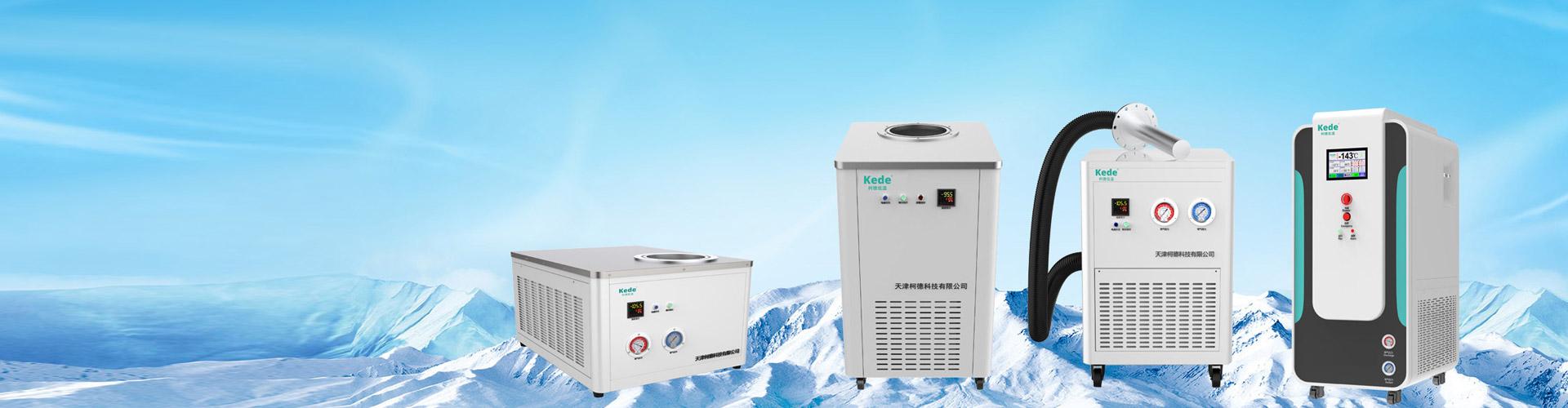
Our company independently develops and manufactures cryogenic units. By adopting cascade configuration with one, two or multiple imported compressors, the units achieve a low temperature range from -50℃ to -160℃. They provide an optimal cryogenic solution for customers requiring cold sources within this temperature spectrum. Replacing liquid nitrogen in numerous fields, the -50℃~-160℃ cryogenic units deliver a stable cold supply while bringing considerable economic benefits, and are highly recognized by customers worldwide.
Each cryogenic unit is custom-designed according to the customer’s actual requirements. Our engineers will conduct joint discussions with clients. After confirming parameters such as evaporation temperature, cooling capacity and cooling method of the cryogenic unit, we will formulate a tailored design proposal for the customer.
The units are applicable to aerospace environmental simulation tests and heat sink tests, low-temperature reaction kettles in pharmaceutical and chemical industries, special gas purification, as well as low-temperature distillation, rectification and extraction equipment in the chemical sector.
The ultra-low temperature units adopt imported cascade ultra-low temperature compressor assemblies and world-renowned brand components, ensuring stable performance and reliable operation. Featuring an aesthetic appearance, the equipment operates with low noise and low energy consumption, delivering cost-effectiveness. Controlled by a PLC touchscreen, it supports intuitive human-machine interaction and communication connection with the control center.
Main Scope of Application
Chemical Industry: Low-temperature rectification and purification, special gas purification & separation, rubber crushing, low-temperature grinding.
Pharmaceutical Industry: Temperature-controlled processes such as synthesis, hydrolysis, esterification and etherification.
New Energy Industry: Low-temperature processes in battery production and electrolyte recovery.
Military Industry: Low-temperature testing, inspection and storage.
Aerospace Industry: Thermal vacuum tests, heat sink tests, and low-temperature testing of components and parts.
Environmental Protection: Gas sampling & collection, collection and treatment of waste gas and waste liquid.
Petroleum Industry: Low-temperature liquefaction of LNG and coal mine gas.
Food Industry: Food packaging, ultra-low temperature processing and storage for tuna and other seafood.
Liquid Nitrogen Replacement: Fully replace liquid nitrogen within the applicable temperature range.
Metal Processing: Cryogenic treatment, low-temperature quenching and cryogenic assembly.
Customization: A full range of models available; various non-standard ultra-low temperature refrigeration equipment can be customized according to user requirements.
Application of Heat Transfer Fluid
When cryogenic units are used in pharmaceuticals, chemical engineering, aerospace heat sink tests and other industries, a heat transfer fluid circulation system is usually required between the cryogenic unit and the customer's reaction vessel load.
Main Reasons
Customer loads are generally large in volume. Filling the load with refrigerant to ensure uniform temperature distribution will cause massive vaporization of low-temperature refrigerant at room temperature, resulting in excessive gas volume and pressure beyond the equipment's bearing capacity.
The on-site load area is often far from the refrigeration room, and the load zone is usually a clean, explosion-proof and quiet area. The heat transfer fluid circulation system separates the cryogenic unit from the load area, improving the overall safety and reliability of the system.
Cooling is realized through heat exchange coils inside the load. Leakage of the coils may contaminate materials. The heat transfer fluid selected is compatible with material solvents, which completely avoids contamination risks even in case of leakage.
The heat transfer fluid acts as a cold storage medium. It can adjust cooling capacity when the load fluctuates greatly, facilitating precise temperature control and energy saving. Generally, the larger the load fluctuation, the higher the required volume of heat transfer fluid.
Higher heat exchange efficiency than liquid nitrogen. Liquid nitrogen releases cooling capacity via latent heat of vaporization and turns into gas after heat absorption, forming a gas-liquid two-phase mixture inside coils. This causes high air resistance, sharply reduces flow rate, prevents full contact between liquid nitrogen and pipe walls, and greatly lowers heat exchange efficiency.